The way people search for information online is undergoing a massive transformation.
For more than two decades, traditional search engines such as Google and Bing have been the primary gateways to information on the internet. Businesses invested heavily in Search Engine Optimization (SEO) to improve rankings, attract visitors, and generate leads through organic search traffic.
Today, however, user behavior is changing rapidly.
Instead of typing keywords into Google and browsing through multiple websites, users are increasingly asking questions directly to artificial intelligence tools like ChatGPT, Google Gemini, Claude, Perplexity, and other AI-powered search platforms. These systems provide instant answers, summarize information from multiple sources, and often eliminate the need for users to visit numerous webpages.
This shift is creating a new challenge and opportunity for marketers, business owners, and content creators.
If AI systems are becoming the new gateway to information, how can businesses ensure their content gets discovered, trusted, and cited by these platforms?
The answer lies in Generative Engine Optimization (GEO).
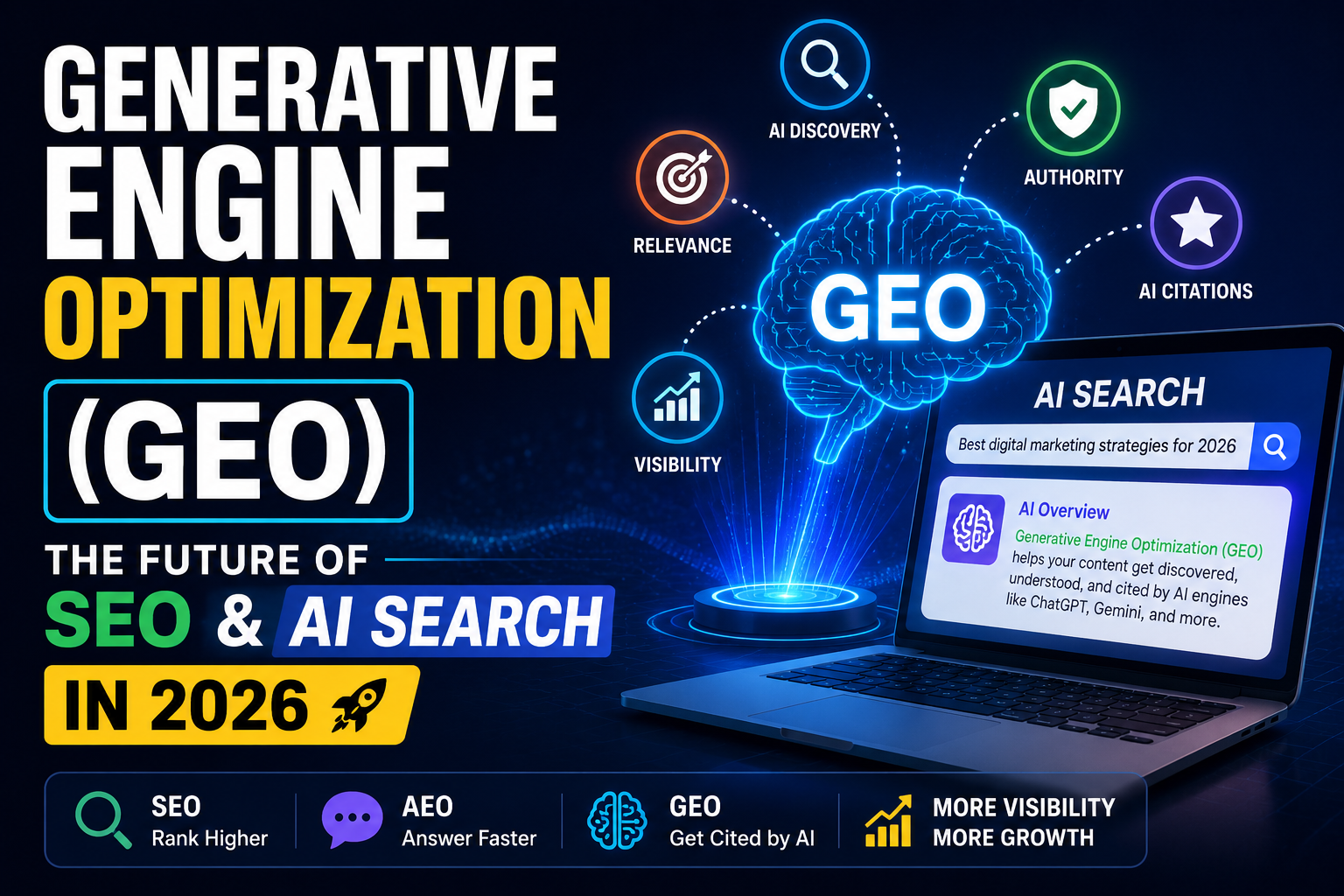
Generative Engine Optimization is quickly becoming one of the most important digital marketing strategies for the future. While SEO focuses on ranking webpages and AEO (Answer Engine Optimization) focuses on providing direct answers, GEO focuses on ensuring your content becomes a trusted source for AI-generated responses.
As AI-powered search continues to grow, businesses that adopt GEO strategies early will gain a significant advantage in visibility, authority, and brand recognition.
In this comprehensive guide, you’ll learn everything you need to know about Generative Engine Optimization, including how it works, why it matters, key optimization techniques, and how GEO complements traditional SEO strategies.
What is Generative Engine Optimization (GEO)?
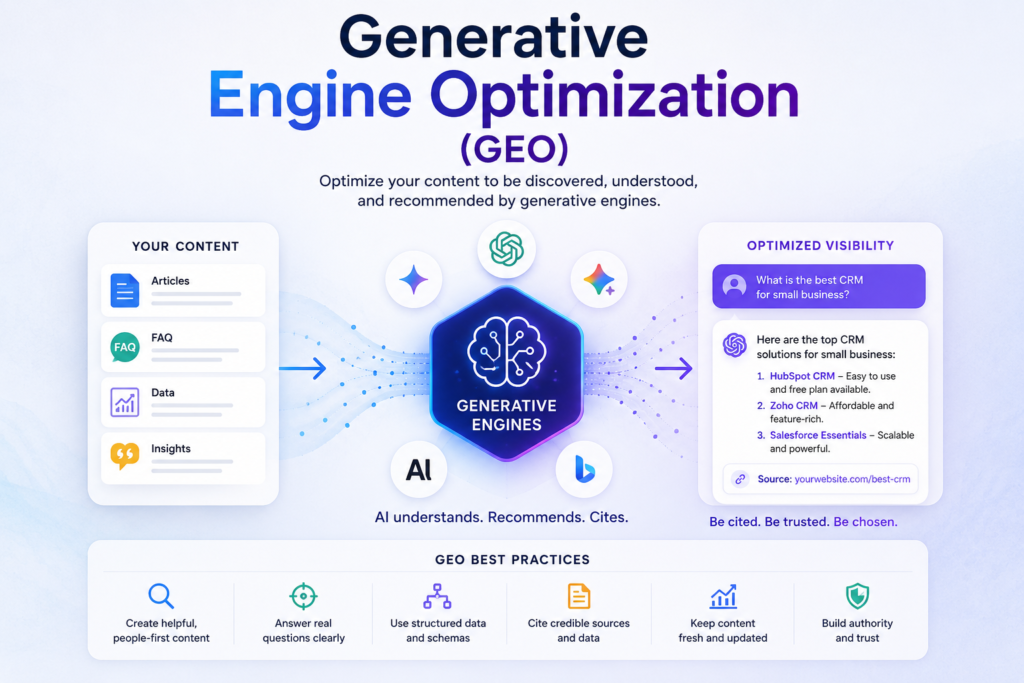
Generative Engine Optimization (GEO) is the process of optimizing digital content so that artificial intelligence systems can easily discover, understand, trust, and reference it when generating responses to user queries.
Unlike traditional search engines that display a list of links, AI-powered platforms generate complete answers by analyzing information from multiple sources.
When a user asks:
“What’s the best digital marketing strategy for a small business?”
An AI assistant may provide a detailed response summarizing information gathered from various authoritative websites.
If your content is considered reliable and relevant, it has a higher chance of being included in that generated answer.
This is the primary goal of GEO.
Rather than focusing solely on ranking first in search results, GEO aims to position your content as a trusted knowledge source that AI systems can confidently reference.
The Evolution of Search: From SEO to GEO
Understanding GEO requires understanding how search has evolved.
Phase 1: Traditional Search (SEO Era)
During the early years of digital marketing, users searched using keywords.
Examples:
- Best digital marketing agency
- SEO services near me
- What is content marketing
Google displayed a list of webpages ranked according to relevance and authority.
Businesses competed for top positions because higher rankings meant more traffic and more customers.
Phase 2: Direct Answers (AEO Era)
As search engines became smarter, they started answering questions directly through:
- Featured Snippets
- People Also Ask sections
- Voice Search Results
- AI Overviews
Users could often get answers without clicking a website.
This led to the rise of Answer Engine Optimization (AEO).
Phase 3: AI-Powered Search (GEO Era)
Today, AI systems generate complete responses using information gathered from multiple sources.
Platforms such as ChatGPT, Gemini, Claude, and Perplexity are changing how people access information.
Users no longer search for links.
They search for answers.
As a result, businesses must optimize content not only for search engines but also for AI engines.
This is where Generative Engine Optimization becomes essential.
Why Generative Engine Optimization Matters
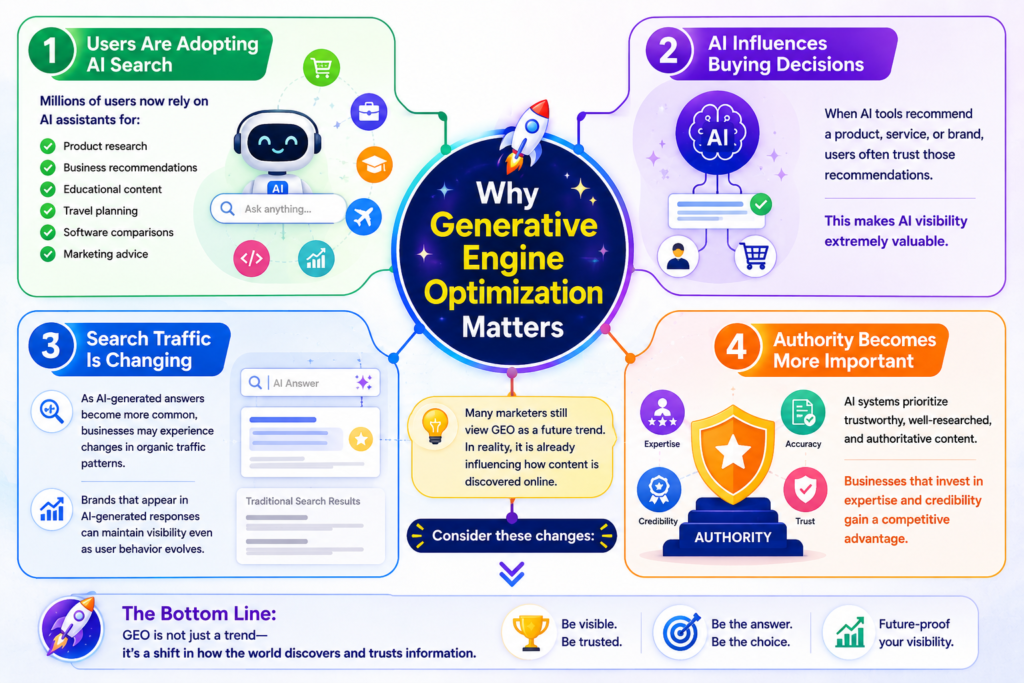
Many marketers still view GEO as a future trend.
In reality, it is already influencing how content is discovered online.
Consider these changes:
Users Are Adopting AI Search
Millions of users now rely on AI assistants for:
- Product research
- Business recommendations
- Educational content
- Travel planning
- Software comparisons
- Marketing advice
AI Influences Buying Decisions
When AI tools recommend a product, service, or brand, users often trust those recommendations.
This makes AI visibility extremely valuable.
Search Traffic Is Changing
As AI-generated answers become more common, businesses may experience changes in organic traffic patterns.
Brands that appear in AI-generated responses can maintain visibility even as user behavior evolves.
Authority Becomes More Important
AI systems prioritize trustworthy, well-researched, and authoritative content.
Businesses that invest in expertise and credibility gain a competitive advantage.
How GEO Works
AI systems evaluate content differently than traditional search engines.
They consider context, knowledge, relevance, and credibility rather than just keywords.
Several factors influence whether AI platforms reference your content.
Content Quality
High-quality content provides comprehensive answers and valuable insights.
AI systems prefer content that solves user problems thoroughly.
Contextual Relevance
Content should match the intent behind a user’s question.
Understanding search intent is critical for GEO success.
Topical Authority
Publishing multiple articles around a specific subject helps establish expertise.
For example, a digital marketing website should create content about:
- SEO
- GEO
- AEO
- PPC Advertising
- Social Media Marketing
- Conversion Rate Optimization
This demonstrates deep subject knowledge.
Trust Signals
AI systems favor websites that show:
- Author expertise
- Business credibility
- Positive brand reputation
- Reliable sources
- Updated information
GEO vs SEO: Understanding the Difference
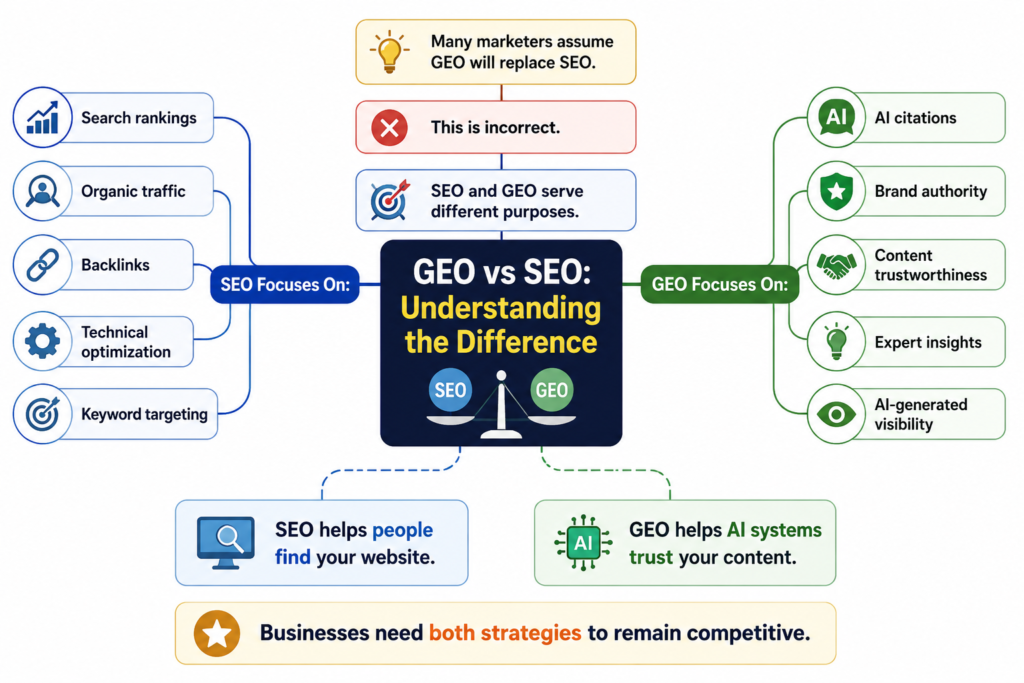
Many marketers assume GEO will replace SEO.
This is incorrect.
SEO and GEO serve different purposes.
SEO Focuses On:
- Search rankings
- Organic traffic
- Backlinks
- Technical optimization
- Keyword targeting
GEO Focuses On:
- AI citations
- Brand authority
- Content trustworthiness
- Expert insights
- AI-generated visibility
SEO helps people find your website.
GEO helps AI systems trust your content.
Businesses need both strategies to remain competitive.
Practical GEO Strategies for Businesses
Create Expert-Level Content
Generic content is unlikely to be cited by AI platforms.
Instead, focus on:
- Original insights
- Industry expertise
- Detailed explanations
- Real-world examples
The more value your content provides, the more likely it will be referenced.
Build a Strong Brand Presence
AI systems often reference brands with established authority.
Ways to build authority include:
- Publishing case studies
- Earning backlinks
- Appearing in industry publications
- Sharing original research
Use Structured Content
Organize information clearly using:
- H2 headings
- H3 subheadings
- Bullet points
- Numbered lists
- Tables
- FAQs
This improves readability for both users and AI systems.
Add FAQ Sections
FAQ sections are valuable because they align closely with how users interact with AI platforms.
Example:
What is Generative Engine Optimization?
Generative Engine Optimization is the practice of optimizing content so AI-powered search engines can discover, understand, and cite it when generating responses.
The Role of E-E-A-T in GEO
Google’s E-E-A-T framework is becoming increasingly important for AI search visibility.
E-E-A-T stands for:
- Experience
- Expertise
- Authoritativeness
- Trustworthiness
Content that demonstrates these qualities is more likely to be trusted by both search engines and AI systems.
Ways to improve E-E-A-T include:
- Adding author bios
- Sharing real-world experience
- Citing reputable sources
- Publishing accurate information
- Maintaining content freshness
The Future of GEO
Generative Engine Optimization is still in its early stages.
However, the trend is clear.
AI-powered search is becoming a major source of information discovery.
Businesses that adapt today will gain a substantial advantage tomorrow.
The future belongs to brands that become trusted sources of knowledge rather than simply websites competing for rankings.
As AI continues to influence how users search, learn, and make purchasing decisions, GEO will become as important as SEO is today.
Conclusion
Generative Engine Optimization represents the next evolution of digital visibility.
Traditional SEO remains essential, but businesses must now think beyond rankings and traffic.
The goal is no longer just to appear in search results.
The goal is to become a trusted source that AI systems reference when answering questions.
Companies that invest in GEO today will build stronger authority, greater brand recognition, and sustainable visibility across both traditional search engines and AI-powered platforms.
In 2026 and beyond, success will belong to businesses that combine SEO, AEO, and GEO into a unified search strategy designed for the future of AI-driven search.