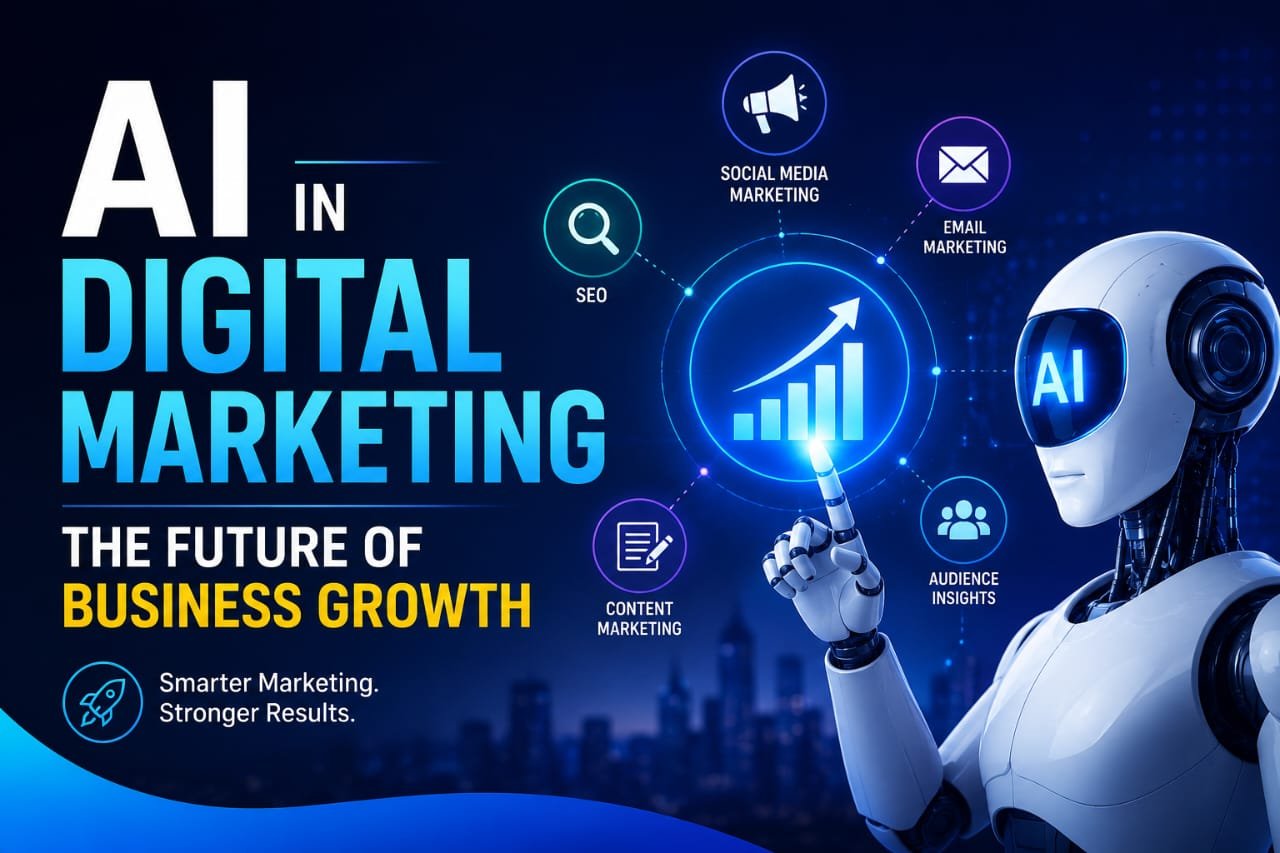
Over the past ten years, digital marketing has changed quickly, but nothing has sped up change like artificial intelligence. From content creation and customer support to search engine optimization and advertising, AI is transforming how businesses connect with their audiences.
Today, consumers expect personalized experiences, faster responses, and highly relevant content. Meeting these expectations manually is becoming increasingly difficult. This is where AI in Digital Marketing plays a crucial role.
Artificial intelligence enables marketers to analyze large amounts of data, automate repetitive tasks, predict customer behavior, and create more effective campaigns. Businesses of all sizes are using AI-powered solutions to improve efficiency, reduce costs, and drive better results.
As we move further into 2026, AI is no longer a competitive advantage alone—it’s becoming a business necessity. Understanding how AI is reshaping marketing can help organizations stay ahead of competitors and deliver exceptional customer experiences.
What Is AI in Digital Marketing?
AI in digital marketing refers to the use of artificial intelligence technologies such as machine learning, natural language processing, predictive analytics, and automation to improve marketing activities.
These technologies help marketers:
- Analyze customer data
- Automate marketing tasks
- Predict buying behavior
- Personalize content
- Improve customer engagement
- Optimize advertising campaigns
Rather than replacing marketers, AI serves as a powerful assistant that helps teams work smarter and make better decisions.
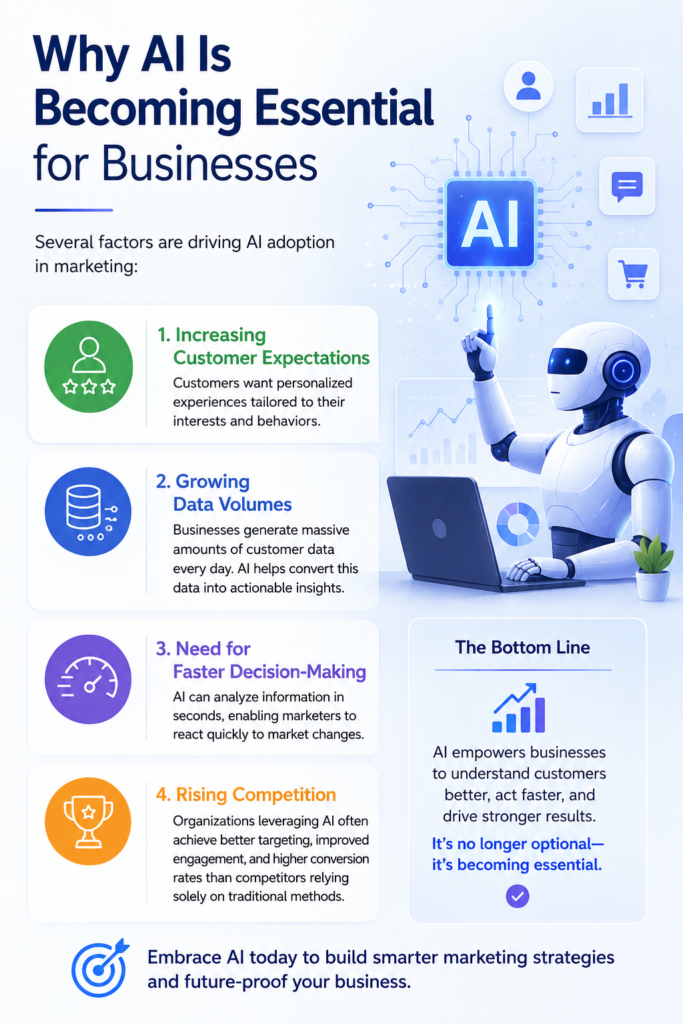
Why AI Is Becoming Essential for Businesses
Several factors are driving AI adoption in marketing:
Increasing Customer Expectations
Customers want personalized experiences tailored to their interests and behaviors.
Growing Data Volumes
Every day, businesses produce enormous volumes of client data. AI helps convert this data into actionable insights.
Need for Faster Decision-Making
AI can analyze information in seconds, enabling marketers to react quickly to market changes.
Rising Competition
Organizations leveraging AI often achieve better targeting, improved engagement, and higher conversion rates than competitors relying solely on traditional methods.
AI in Digital Marketing: Key Transformations
AI-Powered Content Creation
Creating high-quality content consistently can be challenging.
AI tools help marketers:
- Generate blog outlines
- Create social media captions
- Write email drafts
- Develop ad copy
- Generate content ideas
For example, a marketing team can use AI to create multiple versions of ad copy and test which performs best.
However, human creativity remains essential for storytelling, brand voice, and strategic thinking.
Predictive Analytics
To predict future consumer behavior, predictive analytics makes use of machine learning and historical data.
Businesses can predict:
- Purchase intent
- Customer churn
- Product demand
- Campaign performance
Example:
An e-commerce store can identify customers likely to make a purchase within the next week and target them with personalized offers.
This leads to more efficient marketing spend and improved ROI.
Personalized Customer Experiences
Customer satisfaction now heavily depends on personalization.
AI helps businesses personalize:
- Website experiences
- Product recommendations
- Email campaigns
- Content suggestions
- Customer journeys
Streaming platforms, online retailers, and SaaS companies heavily rely on AI-driven personalization to increase engagement and retention.
Customers are more likely to purchase when content feels relevant to their needs.
AI Chatbots and Customer Support
AI chatbots have significantly improved customer service capabilities.
Benefits include:
- 24/7 support availability
- Instant responses
- Reduced support costs
- Improved customer satisfaction
Contemporary chatbots are capable of answering frequently asked questions, qualifying leads, setting up appointments, and assisting users in making purchases.
For businesses generating large numbers of inquiries, chatbots provide substantial efficiency gains.
AI in SEO and Search Optimization
SEO is becoming increasingly data-driven, making AI an invaluable tool.
AI assists with:
- Keyword research
- Content optimization
- Search intent analysis
- Technical SEO audits
- Competitor analysis
Marketers can identify ranking opportunities faster and create content aligned with user intent.
AI-powered SEO tools also help detect content gaps and recommend improvements that increase organic visibility.
AI for Social Media Marketing
Managing multiple social platforms manually requires significant effort.
AI can help with:
- Content scheduling
- Caption generation
- Trend identification
- Audience analysis
- Performance reporting
Businesses can better understand audience preferences and optimize content strategies accordingly.
AI also helps identify the best posting times for maximum engagement.
AI-Powered Email Marketing
One of the channels with the highest return on investment is still email marketing.
AI enhances email campaigns by:
- Segmenting audiences automatically
- Personalizing subject lines
- Optimizing send times
- Predicting open rates
- Recommending products
Instead of sending generic messages, businesses can deliver highly targeted emails that resonate with individual subscribers.
This often results in higher open rates, click-through rates, and conversions.
AI in Paid Advertising and PPC
Paid advertising platforms increasingly rely on AI-driven automation.
AI helps optimize:
- Bid strategies
- Audience targeting
- Budget allocation
- Ad placement
- Creative testing
Machine learning is used by platforms such as Google Ads and Meta Ads to continuously enhance campaign success.
Advertisers can achieve better results while reducing manual optimization efforts.
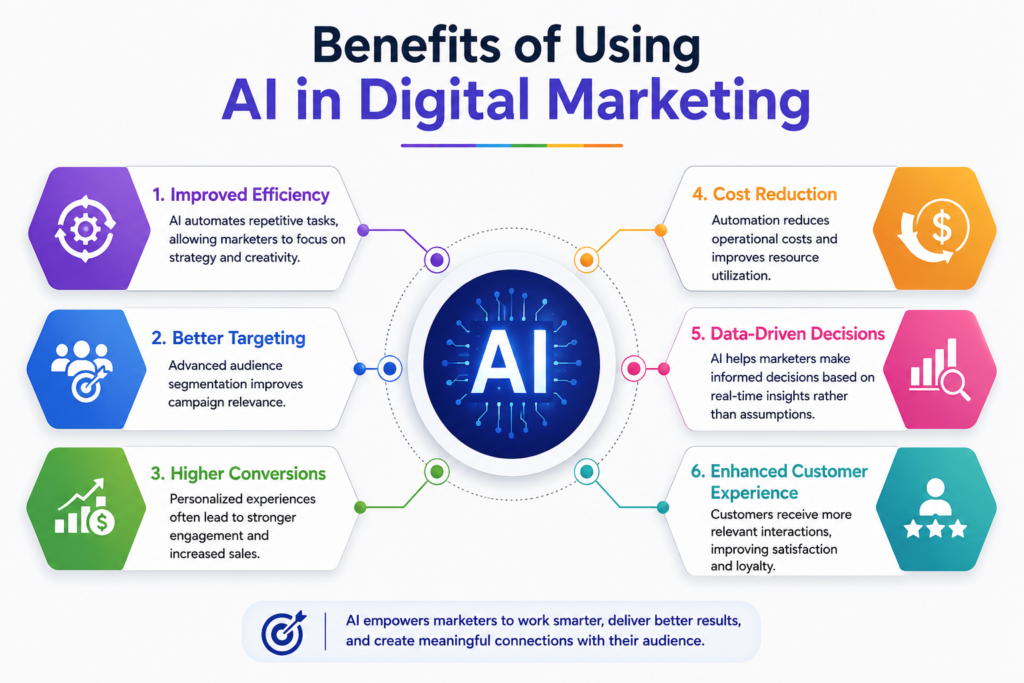
Benefits of Using AI in Digital Marketing
- Improved Efficiency
AI automates repetitive tasks, allowing marketers to focus on strategy and creativity.
- Better Targeting
Advanced audience segmentation improves campaign relevance.
- Higher Conversions
Personalized experiences often lead to stronger engagement and increased sales.
- Cost Reduction
Automation increases resource efficiency and lowers operating expenses.
- Data-Driven Decisions
AI helps marketers make informed decisions based on real-time insights rather than assumptions.
- Enhanced Customer Experience
Customers receive more relevant interactions, improving satisfaction and loyalty.
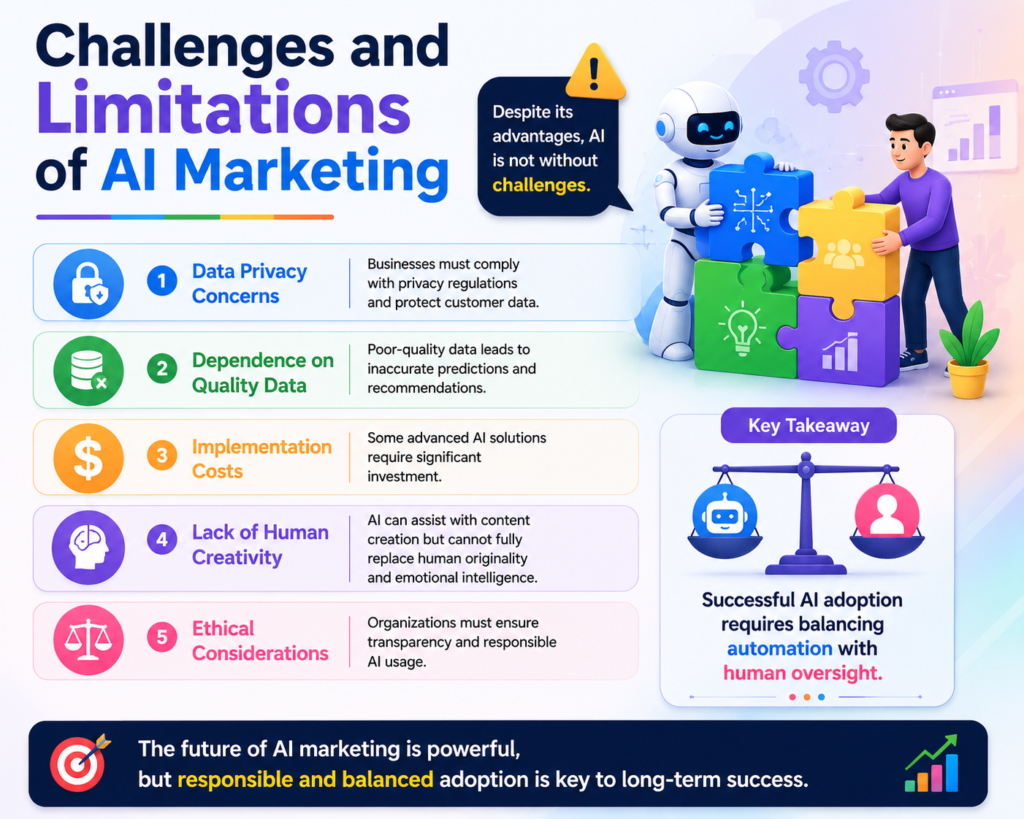
Challenges and Limitations of AI Marketing
AI has advantages, but it also has drawbacks.
- Data Privacy Concerns
Businesses must comply with privacy regulations and protect customer data.
- Dependence on Quality Data
Poor-quality data leads to inaccurate predictions and recommendations.
- Implementation Costs
Some advanced AI solutions require significant investment.
- Lack of Human Creativity
AI can assist with content creation but cannot fully replace human originality and emotional intelligence.
- Ethical Considerations
Organizations must ensure transparency and responsible AI usage.
Successful AI adoption requires balancing automation with human oversight.
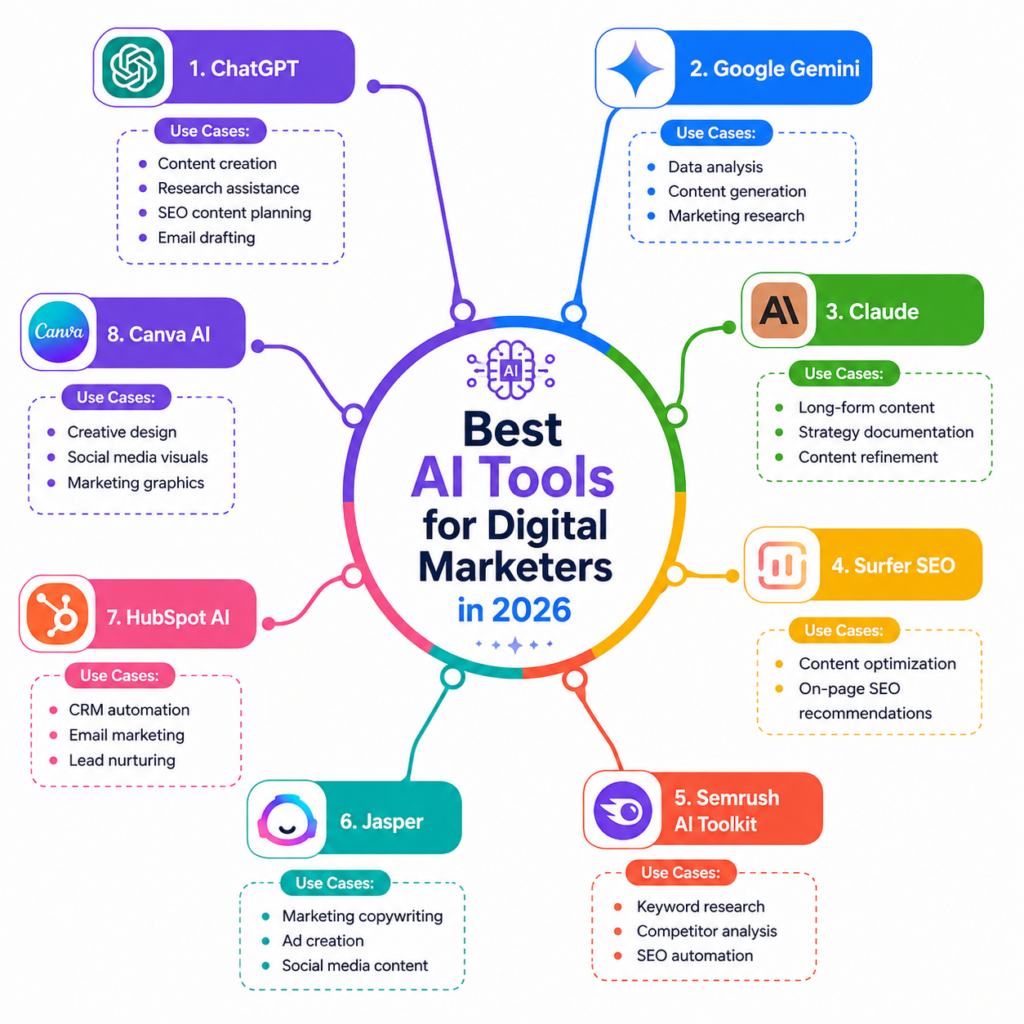
Best AI Tools for Digital Marketers in 2026
Use Cases:
- Content creation
- Research assistance
- SEO content planning
- Email drafting
Use Cases:
- Data analysis
- Content generation
- Marketing research
Use Cases:
- Long-form content
- Strategy documentation
- Content refinement
Use Cases:
- Content optimization
- On-page SEO recommendations
Use Cases:
- Keyword research
- Competitor analysis
- SEO automation
Use Cases:
- Marketing copywriting
- Ad creation
- Social media content
Use Cases:
- CRM automation
- Email marketing
- Lead nurturing
Use Cases:
- Creative design
- Social media visuals
- Marketing graphics
Future of AI in Digital Marketing
The future of marketing will be increasingly AI-driven.
Emerging trends include:
- Hyper-Personalization
AI will deliver even more individualized experiences across channels.
- Voice Search Optimization
Businesses will optimize content for conversational search queries.
- Predictive Customer Journeys
Marketers will anticipate customer needs before they arise.
- AI-Generated Video Content
Video creation will become faster and more scalable.
- Advanced Marketing Automation
Entire customer journeys may be automated while maintaining personalized interactions.
Organizations that embrace these innovations early will gain a significant competitive advantage.
How Businesses Can Get Started with AI Marketing
Follow these practical steps:
Step 1: Identify Marketing Challenges
Find the areas where automation can make the biggest difference.
Step 2: Start Small
Begin with one area such as content creation, email marketing, or customer support.
Step 3: Invest in the Right Tools
Choose AI platforms that align with your business objectives.
Step 4: Train Your Team
Ensure employees understand how to use AI effectively.
Step 5: Monitor Performance
Track key metrics and continuously optimize your strategy.
Step 6: Combine AI With Human Expertise
Use AI as an enhancement rather than a replacement for skilled marketers.
Conclusion
The influence of AI in Digital Marketing continues to grow across every aspect of the customer journey. From content creation and SEO to predictive analytics and personalized experiences, AI is helping businesses become more efficient, data-driven, and customer-focused.
Organizations that leverage AI effectively can improve targeting, increase conversions, reduce costs, and deliver exceptional customer experiences. While challenges such as privacy concerns and implementation complexity remain, the benefits far outweigh the limitations.
Businesses that invest in AI-powered digital marketing solutions today will be better positioned to compete in tomorrow’s increasingly digital marketplace.
If you’re ready to future-proof your marketing strategy, now is the perfect time to explore AI-driven solutions and unlock new growth opportunities for your business.
FAQ Section
AI in digital marketing refers to the use of artificial intelligence technologies to automate, optimize, and improve marketing activities such as SEO, content creation, advertising, and customer engagement.
AI improves performance through automation, personalization, predictive analytics, and data-driven decision-making.
No. AI enhances productivity and efficiency but cannot replace human creativity, strategic thinking, and relationship-building skills.
Popular tools include ChatGPT, Gemini, Claude, Surfer SEO, Semrush AI Toolkit, Jasper, HubSpot AI, and Canva AI.
Yes. Small businesses can use AI to automate repetitive tasks, improve customer engagement, and compete more effectively with larger organizations.