
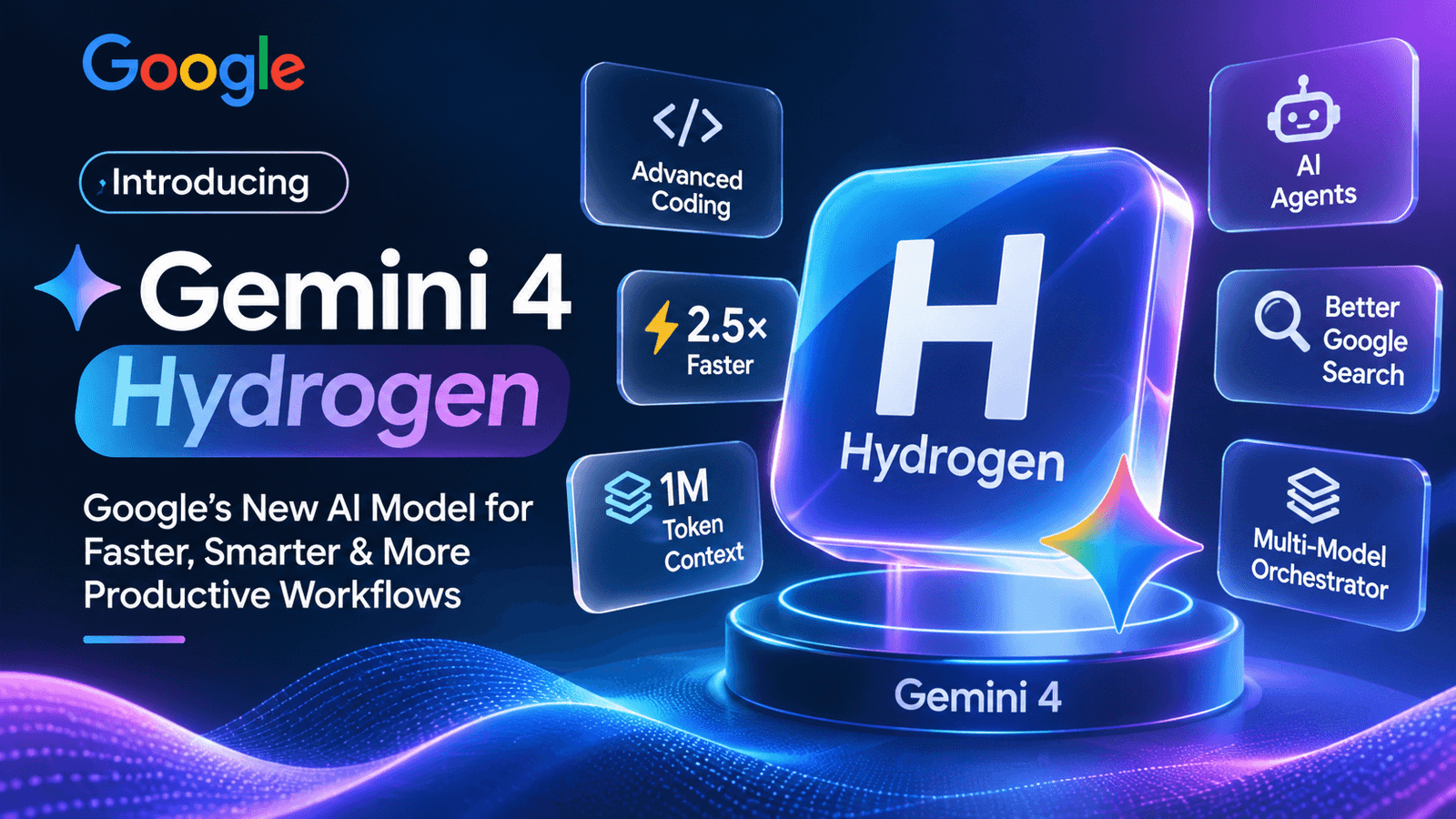
Artificial Intelligence is evolving rapidly, and Google continues to push the boundaries of AI technology with its latest Gemini models. On November 12, 2026, Google officially introduced Gemini 4 Hydrogen, a new AI model designed to deliver advanced intelligence with faster execution and improved efficiency.
Unlike models primarily designed for complex, long-running reasoning tasks, Gemini 4 Hydrogen focuses on everyday productivity, software development, coding and agentic workflows.
The new model also introduces improvements to Google’s AI ecosystem, including Gemini App, Google Search, Google AI Studio and Google Antigravity.
But what exactly is Gemini 4 Hydrogen? What are its new features, how does it perform, and how can developers and businesses benefit from it?
Let’s explore everything you need to know.
Table of Contents
1. What Is Gemini 4 Hydrogen?
Gemini 4 Hydrogen is Google’s AI model designed for fast execution, everyday coding, productivity and agentic workflows. It is part of Google’s Gemini 4 model family and focuses on completing tasks efficiently while maintaining advanced intelligence.
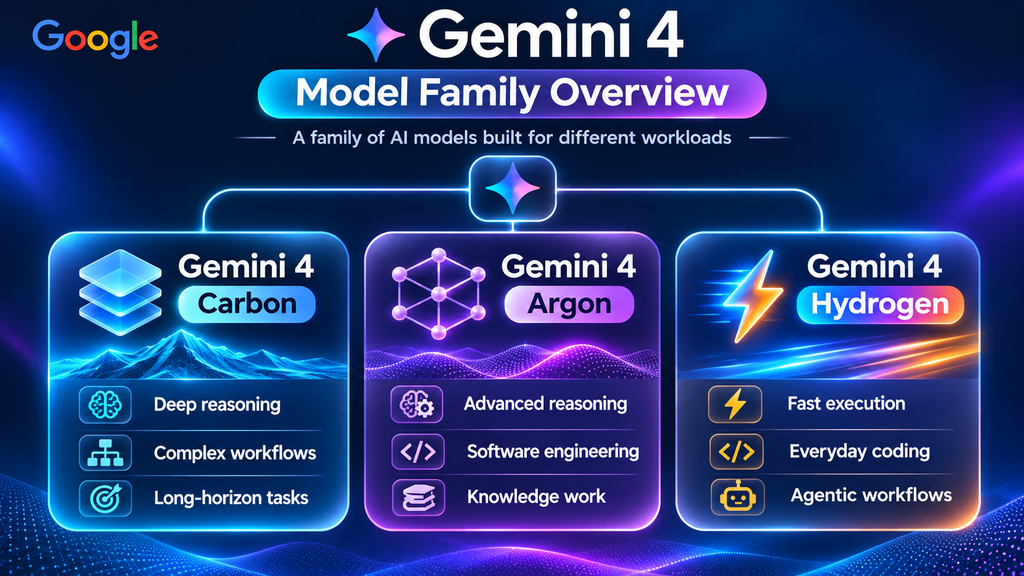
Google introduced Hydrogen alongside its other frontier models, Gemini 4 Carbon and Gemini 4 Argon.
While Carbon and Argon are designed for deeper, long-horizon reasoning and complex problem-solving, Hydrogen focuses on rapid execution across different workflows.
This makes it particularly useful for:
- Software development and debugging.
- Website and application development.
- Research and data analysis.
- Document and spreadsheet processing.
- AI-powered task automation.
- Multi-step agentic workflows.
- Everyday productivity tasks.
One of its important advantages is that it can operate independently or work alongside other Gemini models to complete more complicated projects.
2. Key Features of Gemini 4 Hydrogen
Gemini 4 Hydrogen introduces several capabilities designed to improve productivity, speed and AI-assisted development.
2.1 Faster AI Performance
Speed is one of the major improvements in Gemini 4 Hydrogen.
According to Google, Hydrogen completes tasks up to 2.5 times faster than Gemini 3.8 Flash at its default High thinking level.
This can help developers reduce the time required for repetitive coding, debugging, testing and other development activities.
2.2 Advanced Coding and Debugging
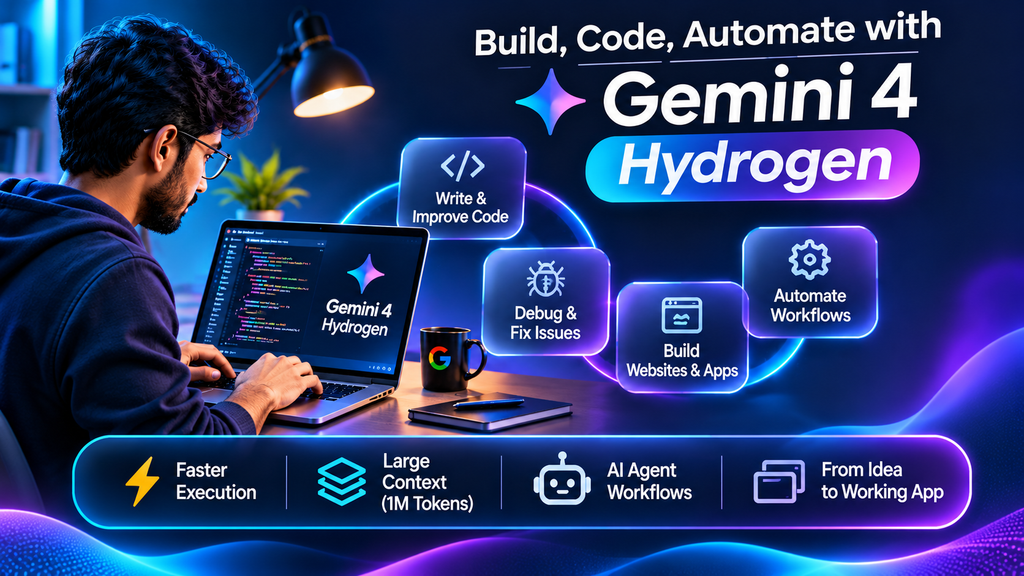
Gemini 4 Hydrogen is designed to support practical software development workflows.
Its coding capabilities include:
- Identifying and fixing programming errors.
- Understanding large code repositories.
- Writing and modifying existing code.
- Debugging applications.
- Developing interactive website layouts.
- Building application prototypes.
- Running tests and verifying changes.
Google also highlights its ability to make focused code changes without unnecessarily rewriting unrelated files.
This can be particularly valuable for developers working on existing applications and large software projects.
2.3 One Million Token Context Window
Another important feature is its support for a 1-million-token input context window and up to 1 million output tokens.
A large context window allows AI models to process extensive information within a single interaction.
For example, developers can work with large codebases, while business professionals can analyse extensive documents, spreadsheets and reports.
Gemini 4 Hydrogen can also process supported multimodal information, including PDFs, charts, audio and recorded video, and turn it into structured reports and deliverables.
2.4 Four Thinking Levels
Gemini 4 Hydrogen provides four thinking levels to balance response quality, speed and cost.
| Thinking Level | Best Use |
|---|---|
| Low | Simple tasks and faster responses |
| Medium | Everyday work and balanced reasoning |
| High | Advanced reasoning and problem-solving |
| XHigh | Complex tasks requiring deeper reasoning |
Users can select an appropriate thinking level depending on the complexity of their requirements.
2.5 Improved AI Agent Workflows
Agentic AI refers to AI systems that can plan, execute and complete multiple steps to achieve a particular objective.
Gemini 4 Hydrogen is designed to support these workflows by interacting with tools, processing information and handling tasks through multiple execution steps.
For example, an AI agent could analyse a project requirement, write code, execute tests and verify the results.
This makes Hydrogen useful beyond traditional question-and-answer interactions.
3. Gemini 4 Hydrogen Performance and Benchmarks
Google has highlighted several performance improvements compared with its previous Gemini 3.8 Flash model.
Some of the key reported results include:
| Performance Metric | Reported Result |
|---|---|
| Task completion speed | Up to 2.5× faster |
| Terminal-Bench 4.1 | 57% vs. 18.2% |
| Enterprise workflow speed | 2×–2.8× faster in selected partner tests |
| Token usage | 12%–23% lower in selected partner workflows |
Google also reports that Hydrogen reduces fabricated claims by more than five times in its highlighted evaluations.
These improvements demonstrate its focus on speed, reliability and efficient execution.
However, benchmark results depend on the task, configuration and testing environment. They should not be interpreted as guaranteed performance improvements for every application.
4. What Is Google Antigravity Orchestrator?
One of the interesting announcements alongside Gemini 4 Hydrogen is Orchestrator in Google Antigravity.
Orchestrator is designed to coordinate multiple AI models instead of relying on a single model to complete every stage of a project.
For example:
- Gemini 4 Carbon can handle complex planning and architectural decisions.
- Gemini 4 Hydrogen can execute coding and testing tasks.
- Multiple AI agents can work simultaneously on different parts of a project.
Google reports that Orchestrator achieved near-Carbon task success rates on Terminal-Bench 4.0 while consuming 24% less quota and completing tasks 19% faster on average.
This approach can help development teams complete complex projects more efficiently by assigning different responsibilities to suitable AI models.
5. How Gemini 4 Hydrogen Improves Google Search
Google has also announced improvements to its Search experience powered by Gemini 4 Hydrogen.
There are three important areas of improvement.
A. Better Understanding of Search Intent
Users can search using natural language, including complicated questions, multiple requirements and even typing errors.
Google aims to understand the actual intention behind these queries and provide more relevant results.
B. More Visual Search Responses
Google is improving its ability to provide visual and easy-to-understand responses.
This can help users find information through more intuitive search experiences.
C. Improved Query Fan-Out
Query Fan-out is a technique that explores different aspects of a user’s search query to identify additional relevant information.
Google says it is upgrading this capability to connect users with a broader range of useful website links.
What Does This Mean for SEO Professionals?
For SEO specialists and website owners, these improvements highlight the importance of creating useful, comprehensive and trustworthy content.
Here are some practical SEO recommendations:
- Understand the actual search intent behind keywords.
- Answer important questions clearly.
- Organise content using descriptive headings.
- Include relevant supporting information.
- Add credible sources and factual references.
- Cover related topics naturally.
- Create content that provides genuine value to readers.
Important: These changes should not be confused with a separate Google Core Update. Google has not announced Gemini 4 Hydrogen as a new standalone ranking algorithm update.
6. Gemini 4 Hydrogen for Developers and Businesses
Gemini 4 Hydrogen can support different professional workflows.
| For Website Developers | Developers can use Hydrogen for coding, debugging, interactive website development and application prototyping. |
| For Digital Marketers | Digital marketers can use AI-assisted workflows for research, content planning, competitor analysis, reporting and repetitive operational tasks. |
| For SEO Specialists | SEO professionals can explore opportunities in keyword research, content analysis, website audits and content optimisation. |
| For Business Owners | Business owners can use AI to analyse documents, prepare reports, process business information and improve productivity. |
| For Enterprises | Enterprise teams can explore multi-agent workflows, data analysis, automation and AI-assisted software development. |
7. How to Access Gemini 4 Hydrogen
Google has announced a global rollout of Gemini 4 Hydrogen across its developer, enterprise and consumer platforms.
Here are the main ways to access it:
- Gemini App: Select the available model from the model selection menu.
- Google AI Studio: Experiment with the model and build AI-powered applications.
- Gemini API: Integrate Hydrogen into your own software and applications.
- Google Antigravity: Eligible Google AI Pro and Ultra subscribers can explore Hydrogen-powered development workflows.
- Google Search: Access its improved Search experience as the rollout reaches users.
- Gemini for Business: Explore enterprise AI workflows and integrations.
Free Gemini App users can access Hydrogen through automatic model selection when Google determines it is appropriate for their prompts.
Availability and access conditions can vary depending on the product and subscription.
8. Gemini 4 Hydrogen vs Previous Gemini Models
Google’s Gemini 4 family includes models designed for different types of workloads.
| Model | Primary Focus |
|---|---|
| Gemini 4 Carbon | Deep reasoning and complex problem-solving |
| Gemini 4 Argon | Advanced reasoning and demanding tasks |
| Gemini 4 Hydrogen | Fast execution, coding and agentic workflows |
| Gemini 3.8 Flash | Previous-generation comparison model |
The main difference is the intended workload.
Hydrogen is designed for rapid execution, while Carbon and Argon focus on more demanding reasoning tasks.
Choosing the right model depends on the complexity of the task, required performance and available budget.
9. Frequently Asked Questions (FAQs)
What is Gemini 4 Hydrogen?
Gemini 4 Hydrogen is Google’s AI model introduced on November 12, 2026. It focuses on fast execution, coding, productivity and agentic workflows.
Is Gemini 4 Hydrogen free?
Free users can access Hydrogen through automatic model selection in the Gemini App when appropriate. API usage is separately priced.
What is the context window of Gemini 4 Hydrogen?
It supports a 1-million-token input context window and up to 1 million output tokens, according to Google’s announcement.
Can Gemini 4 Hydrogen build websites?
Yes. It supports website development, interactive UI prototyping, design-to-code workflows and application development.
What are the four thinking levels in Gemini 4 Hydrogen?
The four thinking levels are Low, Medium, High and XHigh. They help balance response speed, reasoning depth and cost.
What is Google Antigravity Orchestrator?
Orchestrator is a multi-model coordination system in Google Antigravity that dynamically switches between models such as Carbon and Hydrogen to complete different stages of a task.
Is Gemini 4 Hydrogen useful for digital marketing?
Yes. It can support content research, data analysis, reporting, content planning and workflow automation. Human review and marketing strategy remain important.
Does Gemini 4 Hydrogen change Google SEO rankings?
Google has announced improvements to Search understanding, visual responses and Query Fan-out. However, it has not announced Hydrogen as a separate Google Search ranking update.
10. Final Thoughts
Gemini 4 Hydrogen represents an important development in Google’s AI ecosystem, particularly for users who need fast execution, coding support and intelligent task automation.
Its improvements in developer workflows, large-context processing, multimodal knowledge work and multi-model collaboration make it an interesting option for developers, businesses and digital professionals.
The integration of Hydrogen into Google Search is also worth watching because of its improved understanding of search intent and ability to discover relevant website links.
For digital marketers and SEO professionals, the key takeaway is that AI is becoming more deeply integrated into everyday digital workflows.
Instead of using AI only to generate text, businesses can increasingly use it to research, analyse, build and execute tasks.
Want to stay updated on the latest AI tools, SEO strategies and digital marketing developments? Follow Innovold for more practical technology insights and business growth tips.